I remember when I first aspired to a be a film critic
back in college, my feelings about Siskel and Ebert centered on annoyance that
critical opinions on cinema could be reduced to a few minutes of a TV segment
and a binary “Thumbs Up” or “Thumbs Down” decision. They were hacks, I thought,
and had no place in real discussion of criticism. At some point, however, I
began to watch clips from their show for the entertainment value of their
arguments. Eventually I started actually reading Ebert’s reviews.
A blog mostly dedicated to cinema (including both new and old film reviews; commentary; and as the URL suggests - movie lists, although it has been lacking in this area to be honest), but on occasion touching on other areas of personal interest to me.
Showing posts with label Roger Ebert. Show all posts
Sunday, August 3, 2014
Thursday, April 4, 2013
Roger Ebert Has Taken a Permanent "Leave of Presence"
RIP Roger Ebert (1942 - 2013)
I've read several obituaries and tributes to the man, the best of which can be found here, and nothing I can say will do justice to the life he led and the influence he had as the nation's most recognizable film critic.
In 46 years as film critic for the Chicago Sun-Times, he amassed a catalog of thousands upon thousands of reviews. For a long stretch he ran a bi-weekly Great Movies column. In recent years those columns took a back seat as he focused more on his blog which became his voice online when he no longer could express himself verbally to the people standing next to him. He expounded on a variety of topics including politics, philosophy, religion, evolution, death, video games as art, and his own personal history and memories. If his blog writing had a unifying theme it was the expression of humanity and compassion. He allowed comments on his blog entries. He personally read and approved every single one of them, occasionally even responding. His entries dealing with video games and evolution have thousands of comments posted. His blog was widely praised for having the most sensible and well-behaved readership on the Internet. The level of debate was usually elevated.
Monday, October 24, 2011
The Godfather Film Analysis: Introduction
This is the first introduction to a complete film analysis of The Godfather from 1972. It is still a work in progress and I hope to get it completed with all parts posted by the end of November. This is not meant as a full academic study, but the beginnings of exploring how sequencing, lighting, shot composition and music contribute to cinematic storytelling in great movies.
Unfortunately I am too young to have had the opportunity
to see The Godfather when it first
opened in 1972. I can recall seeing it in bits and pieces throughout my
childhood on television, cable and probably on video. Certain images resonated
and stuck in my mind: the garroting of Carlo and his kicking out the
windshield; Sonny’s violent death at the tollbooth; Sonny’s beating of Carlo on
the street; Jack Woltz waking to find himself covered in blood and the head of
his prized racehorse under the sheets; Michael’s killing of McCluskey and Sollozzo;
the final montage of the baptism inter-cut with the killings of the heads of
the five families. It is certainly no coincidence that the most violent scenes
are what stayed with me all my life. I never had any awareness of the plot of
the film until I watched the film in its entirety sometime when I was a
teenager.
Saturday, February 5, 2011
"Royale With Cheese": Pulp Fiction Analysis Part II
Go to Part I: "Everybody be cool, this is a robbery."
The first scene in the next sequence is probably the most famous scene from the film, certainly the most parodied, and possibly (time will tell) to become one of the most famous scenes in film history. As Jules Winfield (Samuel L. Jackson) and Vincent Vega (John Travolta) drive along they discuss trivial matters regarding the “little differences” between Europe and America . We don’t know where they are headed at this point, but we will find out they are two hit men about to carry out a job. Tarantino puts this scene in because it’s something we’ve never really seen in a film about hit men. What do these guys do on the way to work? They talk about the same things regular people discuss. Revisiting the film for his Great Movies series, Roger Ebert notes that “it is Tarantino's strategy in all of his films to have the characters speak at right angles to the action, or depart on flights of fancy.”[i] Whereas many screenwriters use dialogue simply to further the plot, Tarantino uses it to add color to his characters and vitality to the story. For Jules and Vincent their job is just a job, even though to us it is an extraordinary profession.
Next chapter: "Let's get into character."
![]() |
| Vincent and Jules discuss trivial matters before going on a hit job. |
Next chapter: "Let's get into character."
Wednesday, February 2, 2011
Reordering Convention: Introduction to an Analysis of Pulp Fiction
Following is the introduction to a full shot-by-shot analysis of Pulp Fiction that I did several years ago. This is not meant to be an essay or thesis, but rather an examination of the way Tarantino uses shot setups and narrative devices to effectively tell his story. I will try to post one new section a day over the next few weeks.
Since its release in October 1994, I have seen Pulp Fiction about eighteen times from beginning to end, including six times during its initial theatrical run. No viewing has ever compared to the first time when I was sixteen years old and not yet aware of what the film medium could accomplish. I was not yet versed in film history and I hardly knew from where director Quentin Tarantino was deriving most of his inspiration. All I knew after that first time was that movies did not merely have to be plot-driven. To borrow from Gene Siskel, movies aren’t what they are about, but how they are about it. Movies can be inventive, witty and can change the way we look at motion pictures.
Monday, September 13, 2010
Another from the Celebrity Death Pool Bites the Dust
Many years ago I heard about these celebrity death pools in which people throw their money into a pool to bet on which celebrities will die in the next 6 months. The younger the celebrity who dies and the sooner within the 6 months, the more points you earn. It's a sick game. It's morally depraved at best, but it was so intriguing. I thought about throwing myself into the thick of it and made up a preliminary list of those likely to die.
Sunday, May 2, 2010
The Unfortunate Movement of 3D Cinema
When is the last time you watched a movie and thought to yourself, “I really like this movie, but it looks too two-dimensional and it fails to capture the world as I perceive it?” My guess is you’ve never had that thought about a conventional 2D film. Yet Hollywood is trying to convince you now that your cinema experience has been lacking that third dimension for the last 115 years.
First, for those of you who have yet to experience one of the new generation of 3D movies it’s important to realize that this isn’t the same level as your Jaws 3D or Friday the 13th Part 3D or the Michael Jackson Captain Eo at Epcot Center, Disney World, during which you wear cheap paper glasses with red and cyan filters to enjoy objects poking and flying out of the screen toward you. Anyway, the real entertainment in that was watching the idiots in the cinema trying to grab the objects. No, this new technology works on the same principle, but has advanced far beyond anything previously experienced. Granted, some films are still employing the silly gimmick of flying debris and pokey objects, but the general idea now is to create a deeper and richer cinema experience by adding the further illusion of a third dimension.
I have serious misgivings about the movement toward 3D films (full disclosure: the only modern 3D film I’ve seen is Avatar so my experience is admittedly limited). Roger Ebert has written in opposition to 3D for some time now and has just recently published a piece in Newsweek outlining his arguments against it. For my part, the best argument he makes (and this points to my opening question above) is that 3D doesn’t actually add anything substantial to a movie.
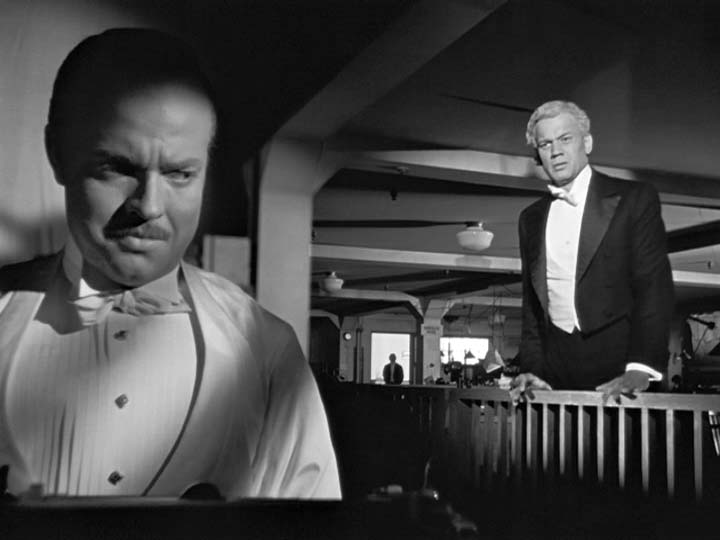
The world we experience is obviously three-dimensional. But we perceive it as such because of physiological processes between the eyes and the brain. There are physiological disorders that affect one's ability to perceive depth in the world, but of course this doesn't indicate an absence of depth. When we watch a movie or look at a photograph or painting (all two-dimensional artistic representations of the world) our minds perceive depth as a result of the same physiological process that allows us to perceive it in the world. Great artists have an almost innate understanding of the characteristics (depth of focus; diminishing scale; contrast; viewing angle) that appeal to our depth perception and are able to manipulate their art to create varying levels of realistic images. Can you really look at this Cezanne painting, unrealistic though it may seem, and tell me that it fails to capture a third dimension? How about still frames from Citizen Kane such as this one or this? What about chalk sidewalk drawings like this? Likewise as Ebert points out in his Newsweek article, when we see T.E. Lawrence appear on the desert horizon and slowly move toward the camera we have no trouble perceiving that he is moving closer to us. A 3D effect is created in a 2D medium without the use of stereophonic glasses.
Essentially, movies already provide us with a 3D illusion. Adding a stereophonic 3D illusion is pointless and distracting. That was my main reaction to Avatar. I was constantly aware that I was watching a movie. The fourth wall was always broken. I found the effect generally worked for the animated sections of the film, but anytime there were live-action characters on screen the illusion was lost on me. It presents a completely unnatural way of seeing the world. When I look at the world I don't think to myself, "Wow! Look at that third dimension!" But watching Avatar gave me that thought almost every minute.
Keep in mind that Avatar was built from the ground up, completely conceived as a 3D movie. James Cameron is a wizard of technology with a history of making films with groundbreaking effects as far back as Aliens, which brilliantly expanded on a classic film, and Terminator 2: Judgment Day (with visual effects that still hold up today) and the mesmerizing Titanic. Don't confuse this kind of pioneering filmmaking with the 3D retrofitting of Clash of the Titans and Alice in Wonderland, both of which were filmed in 2D and then altered after the money earned by Cameron's film. By all accounts, the 3D in those two films was awful.
Like I said, I think the effect works well enough (although unnecessarily) for animation. I've seen a 3D demo of the Monsters vs. Aliens Blu-Ray disc and it looked okay. Ebert allows for this kind of sporadic use but objects to 3D becoming a way of life for Hollywood movies. I have to agree. The 3D effect as used in live action looks completely unnatural. The goal of most narrative film is to recreate reality on screen. An artificial 3D illusion destroys that goal. I can see it being put to good use in live-action films where the story calls for it. But then also only if it's possible to employ the technology during certain scenes or sequences. The Matrix trilogy comes to mind as a film that could use 3D on live action to good effect because that's a story that establishes a computer generated unreal world. Christopher Nolan's upcoming Inception may be another (although from the trailers it looks damn good without it), which is apparently meant to take place in a kind of dreamscape. As far as I know this is not possible without removing and putting on the glasses during the film.
This article tries to refute Ebert's arguments. One of his points is that 3D is a natural progression the same way sound, color, surround sound and widescreen were. Notwithstanding his mis-identification of Singin' in the Rain as the 'first' talking picture (he meant The Jazz Singer while Singin' in the Rain is about the change from silent to sound), Coldeway's understanding of cinematic development is lacking. If narrative film's primary goal is (often) to replicate reality on screen then synchronized sound and color were not gimmicks, but natural developments. Surround sound and widescreen formats were gimmicks which allowed greater freedom and creativity for frame composition in the latter and a richer experience (albeit unnecessary, but not distracting) in the former. I don't currently see 3D falling into this category.
As I've already said, I'm willing to allow for the possibility that a live action film could employ 3D technology to great effect. However, there is still a great obstacle to be overcome as described in this article from last year and this one from January this year. As good as 3D may look with an animated film and may look with some future film, there is still the problem of unnatural movement and focus exerted on your eyes. This is the cause of all those complaints about headaches, eyestrain and nausea during 3D movies. I myself had to periodically remove the glasses during most of Avatar and watch without them for several seconds to give my eyes a rest. Of course, the interlaced images and unnatural brightness make it impossible to watch a 3D projection without the glasses. The additional brightness in Avatar is because the glasses cause a 15-20% light reduction. Hence another reason why you'll want to avoid any film that is retrofitted with 3D - they'll be way too dark.
Unfortunately I don't predict this technology will disappear and go the way of old-school 3D, Cinerama or Smell-o-vision. It's consistently bringing in more and more money for Hollywood studios and theater chains who tack on an additional surcharge for the premium experience of seeing a sub-par product and the privilege of wearing distractingly uncomfortable glasses. My guess is that within 5 years the majority of special effects event films coming out of the major studios (whether live action or animated) will be shot in 3D. More and more cinemas will be buying 3D projectors, thus closing out the market for 2D films. Although I'm sure some directors will begin making films like Up in the Air and Precious in 3D I seriously doubt it will catch on for those types of films.
Subscribe to:
Posts (Atom)
Everything I Saw in the 2nd Half of 2025
30 Dec. Hamnet (2025) [cinema]* 28 Dec. #4133 Song Sung Blue (2025) [cinema] 25 Dec. #4132 Marty Supreme (2025) [cinema] 16 Dec. #4131...
-
When I was in my twelfth grade English class I was fixated on symbolism, loss of innocence metaphors and literature that you could tuck in ...
-
This film will open commercially in the United States on 22 April 2011. Immediately after being born, an infant child is tattooed ...
-
As a staunch non-believer I’ve only ever encountered two films that gave me a sense of what religious fulfillment is. Not that I was spir...