Showing posts with label Francis Ford Coppola. Show all posts

Saturday, March 1, 2014

25 Years Ago This Month: March 1989


As always I start with what I've seen...

Three of the great filmmakers of the 70s and 80s (Woody Allen; Francis Ford Coppola; Martin Scorsese) collaborated on the omnibus film New York Stories which encompasses three short vignettes. The first and best is "Life Lessons" (Scorsese) starring Nick Nolte and Rosanna Arquette about an artist living with his former lover, whose sexual escapades with other men fuel jealousy and a spark of creativity. Coppola's segment is "Life Without Zoe," a sort of fantasy about a girl living in a luxury hotel. "Oedipus Wrecks" is Allen's contribution, about a New York lawyer (played by Allen) haunted by his overbearing mother, who appears in the New York skyline to tell the whole city about her son's personal problems.

I reviewed it last year after taking a second look many years removed, but the cult classic Heathers was released a quarter century ago.

Tuesday, August 6, 2013

25 Years Ago This Month: August 1988

Cheers, Jesus.
The films I've seen

The most significant movie release of the month was The Last Temptation of Christ. Martin Scorsese had been trying for a decade to adapt Kazantzakis' controversial novel and finally got it made with Willem Dafoe in the starring role and Harvey Keitel as a Brooklyn-accented Judas. Of course it was idiotically boycotted by Christian groups, most of whom had probably not even bothered to watch the film to find out exactly what they were objecting to. It has since become one of the more important films in Scorsese's body of work and has been canonized by Criterion into their collection.

The biggest money maker was A Nightmare on Elm Street 4: The Dream Master, which I reviewed last year. It made nearly $50M at the box office and finished 19th for the year.


Now I loved Young Guns when I was a kid. I only ever saw it on cable, but it remains to this day a serious guilty pleasure of mine. Emilio Estevez as Billy the Kid and then there's Kiefer Sutherland, Lou Diamond Phillips, Charlie Sheen, Casey Siemaszko, and a young Dermot Mulroney as his friends. Terence Stamp and Jack Palance add a veneer of respectability, but just a little.

Thursday, May 24, 2012

"I'm a Businessman. Blood Is a Big Expense.": Godfather Analysis Part VIII

Go to Part VII: "And don't lose that famous temper of yours, huh, Sonny?"

The scene in which Sollozzo presents his proposition to Tom takes place in what appears to be an abandoned ‘railroad car’ diner – a long, narrow freestanding building. The only lighting in the scene is a source light, a small lantern on the table near Tom and Sollozzo. There are two close shots on Tom and Sollozzo, only their faces lit, everything else very dark before the cut showing us the room and the light. The shot is almost completely black. We can see the outlines of the characters in the far background and a silhouette of a guard in the foreground, but there is not enough light to give much indication as to where they are. For the Corleone family this is the low point of the film. Luca Brasi has been killed, the Don is near death, Tom has been taken and Sollozzo is about to put the screws to the family. The darkness of this scene is a reflection of that despair.

Wednesday, May 23, 2012

"And Don't Lose That Famous Temper of Yours, huh, Sonny?": Godfather Analysis Part VII


After the violent events of the previous sequence we go first to an establishing shot of the exterior of Radio City Music Hall and then to Michael and Kay coming out from a show. This is another example of how Michael is separate from the business dealings of his family. Immediately after his father is gunned down, there is a cut to some time later (the sun was still out when Vito was shot and here it is night). Their conversation is completely inconsequential until Kay notices the newspapers proclaiming the shooting of Vito Corleone. After Michael rushes across the street to the phone booth to call Sonny, he closes the phone booth door, leaving Kay standing outside. This is shot deliberately to illustrate how Kay is left on the outside. It is the first of many times Michael will close Kay out of his dealings, not only in this film, but continuing into The Godfather Part II as well. Later he will leave her in the hotel when he goes to the hospital to visit his father. When he returns from Sicily and finds Kay he won’t tell her anything about his business other than that he intends to be legitimate in five years’ time. Finally, the closing shot of the film will be the door shutting Kay out of Michael’s office. Michael enters the booth, Kay remains outside. There is a cut to a close up of Kay looking in before the cut to the interior of the phone booth. The conversation Michael has with Sonny lasts 26 seconds and Kay is visible outside the phone booth the whole time, an outsider looking in.

Friday, May 11, 2012

From My Collection: The Outsiders Movie Review

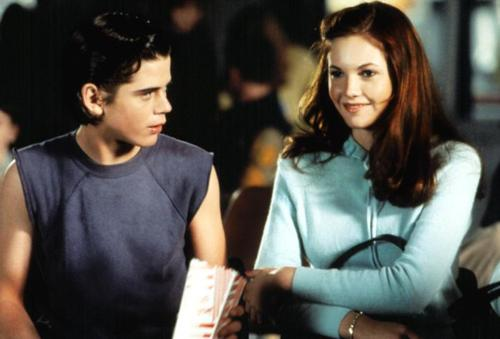
Francis Ford Coppola’s The Outsiders, based on the novel by S.E. Hinton, is one of those iconic movies from my childhood. It was slightly before my time, but I watched it any time I caught it on TV. The boys in the film were old enough that to me they were grown up. Still, something in the story connected with me in a strong way so that I lived and breathed with their actions and, in some cases, their tragic ends. Of course it didn’t hurt that it’s a story about boys being boys without any real authority to direct their rambunctious energy and it all ends with an epic rumble in the rain and mud.

Tuesday, April 24, 2012

"Never Tell Anybody Outside the Family What You're Thinking Again": Godfather Analysis Part V


Now that we’ve been introduced to all the major characters in the film, gotten a sense of their personality traits and seen the power of Don Corleone’s persuasion, it’s time (only 33 minutes into the film) to put the plot in motion and meet the villain. This section opens with Corleone sitting down with Tom and Sonny to begin discussing the possibility of becoming partners with Virgil Sollozzo. Vito asks Tom if he’s too tired and Tom remarks that it’s okay because he slept on the plane. This seemingly banal piece of dialogue does a few things: gives us a time reference so we know this is immediately after Tom’s trip to California; indicates Tom’s professionalism in his loyalty and service to the Don; and shows that the Don wants to get things moving quickly and be well-prepared.

Friday, April 20, 2012

"He Never Asks a Second Favor When He's Been Refused the First": Godfather Analysis Part IV

Go to Part III: "I'm gonna make him an offer he can't refuse."

The next section opens with some stock footage establishing shots of Hollywood and then a few long range shots of Tom making his way around the studio back lot until he finds the soundstage where Jack Woltz is. We know from the last conversation in Don Corleone’s office that Tom was meant to go to California that night. These establishing shots remind us of that conversation and the problem that Johnny is having with getting a part in a new war film.

Wednesday, April 18, 2012

"I'm Gonna Make Him an Offer He Can't Refuse.": Godfather Analysis Part III

Go to Part II: "No Sicilian can refuse any request on his daughter's wedding day."

The family portrait now includes Michael and Kay.
Now Johnny Fontane arrives to the great joy and surprise of Vito, who proclaims that he came “all the way from California.” Tom, being realistic and perhaps a little jealous, points out, “it’s been two years. He’s probably in trouble again.” Of course, Tom turns out to be right as he’s come to ask a favor of the Don.

Tuesday, April 17, 2012

"No Sicilian Can Refuse Any Request on His Daughter's Wedding Day.": Godfather Analysis Part II

Go to Part I: "I believe in America."

After the dark interior opening, the film cuts to a sunny exterior shot of the wedding celebration with music playing and people dancing. This virtuoso opening sequence brilliantly introduces us not only to most of the important characters in the film, but also to some of the key plot points, although we don’t know it yet. The opening sequence in Corleone’s office has an average shot length of just under 27 seconds. The remainder of the wedding sequence averages just under 8 seconds per shot – an indication that the sequence moves quickly, cutting between exterior and interior scenes, revealing all the characters and some of their personality traits that will figure prominently later.

Sunday, November 20, 2011

Classic Movie Review: The Godfather Part II

At the time it was made, could anyone have imagined that a sequel to The Godfather would possibly be anything near to the quality and sophistication of the first film? And yet Francis Ford Coppola surpassed his own film in many ways with The Godfather Part II. It is wider and more epic in scope, covering both the rise of a young Vito Corleone in 1920s Little Italy and the decline of his youngest son Michael 30-odd years later. It covers the ground both before and after the time period in which the first film is set.

Wednesday, November 16, 2011

"I Believe in America": Godfather Analysis Part I

Go to introduction.


That is the line that opens the film over a black frame before a fade in on a close-up of Bonasera. That line sets the tone for the rest of the film and possibly the entire trilogy. In many ways, the film is a celebration of the idea of America and the American dream: an immigrant family settles in New York and builds itself up from having nothing to having everything. America, the land of opportunity, has been very good to the Corleone family.

Monday, October 24, 2011

The Godfather Film Analysis: Introduction


This is the first introduction to a complete film analysis of The Godfather from 1972. It is still a work in progress and I hope to get it completed with all parts posted by the end of November. This is not meant as a full academic study, but the beginnings of exploring how sequencing, lighting, shot composition and music contribute to cinematic storytelling in great movies.


Unfortunately I am too young to have had the opportunity to see The Godfather when it first opened in 1972. I can recall seeing it in bits and pieces throughout my childhood on television, cable and probably on video. Certain images resonated and stuck in my mind: the garroting of Carlo and his kicking out the windshield; Sonny’s violent death at the tollbooth; Sonny’s beating of Carlo on the street; Jack Woltz waking to find himself covered in blood and the head of his prized racehorse under the sheets; Michael’s killing of McCluskey and Sollozzo; the final montage of the baptism inter-cut with the killings of the heads of the five families. It is certainly no coincidence that the most violent scenes are what stayed with me all my life. I never had any awareness of the plot of the film until I watched the film in its entirety sometime when I was a teenager.

Monday, October 3, 2011

25 Years Ago This Month: October 1986

25 Years Ago I was probably just beginning to learn my multiplication table in Mrs. Hansen's third grade class. I don't remember much else about what I learned that year. I remember studying European geography, learning the countries and possibly their capitals. Yugoslavia was still a unified country and I remember, even at age 8, that my classmates were immature in laughing at the name because it was like, "You go slav." The things that stick in our memories.

I certainly wasn't going to the movies so much, but I've seen a half dozen or so of the films that opened in October of 1986. There's little that's particularly notable. The list of releases contains the usual mix of prestige projects aiming for the awards season and popular fluff (action and comedy, mainly) to keep the investors happy.

Everything I Saw in the 2nd Half of 2025

30 Dec. Hamnet (2025) [cinema]* 28 Dec. #4133 Song Sung Blue (2025) [cinema] 25 Dec. #4132 Marty Supreme (2025) [cinema] 16 Dec. #4131...