Showing posts with label biopic. Show all posts

Tuesday, March 8, 2016

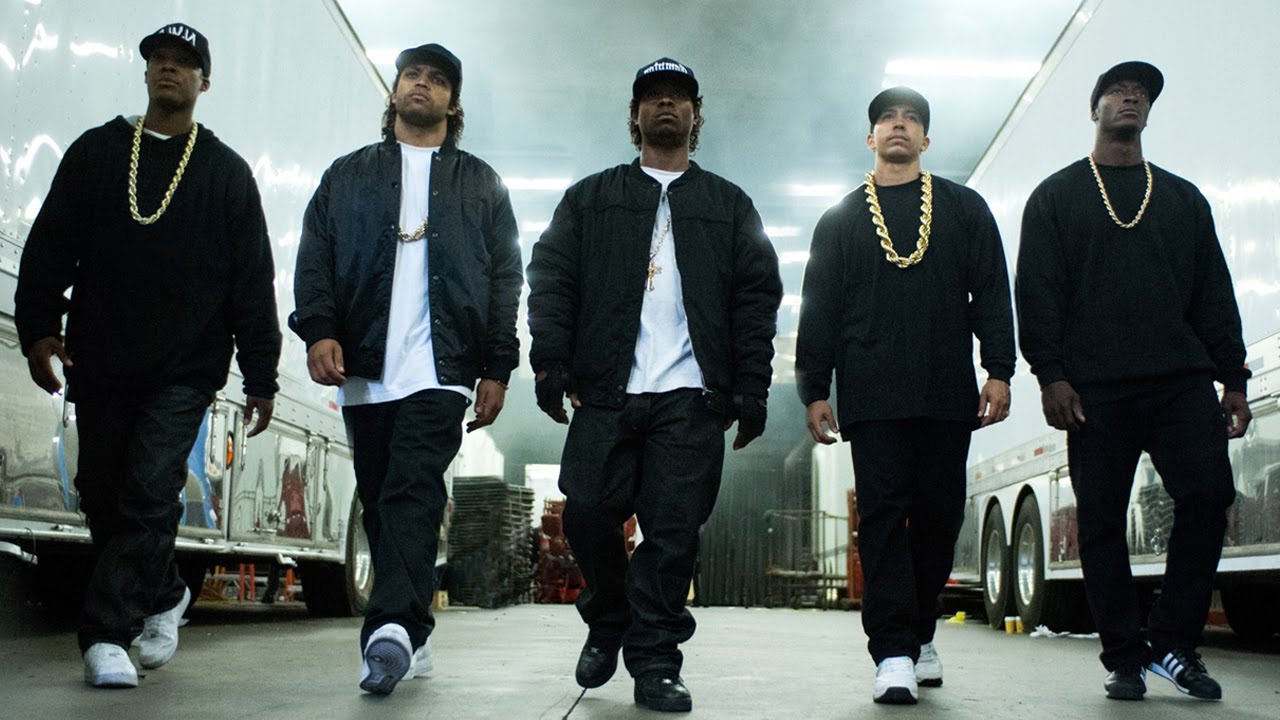
Straight Outta Compton Movie Review


I fail to see what all the fuss and accolades toward Straight Outta Compton is about. Yes, it’s a good movie, well written and acted with a cast of mostly unknown and inexperienced actors. But as a musical biopic, what does it really bring to the table that hasn’t been done countless times before?

The story of the rise of the rap group N.W.A. from a group of friends making music together to a national voice for the powerless inner city black youths in America and FBI pariah is certainly not uninteresting. We’ve all heard of Dr. Dre and Ice Cube. This is where they got their start. Eric “Easy-E” Wright died twenty years ago while DJ Yella and MC Wren are the lesser known members of the group. That Dre and Cube worked as producers on the project should not go unmentioned because it’s pretty clear in the film’s narrative which characters are highlighted most prominently. It’s also worth pointing out that their characters come off as the most morally upstanding while Eric Wright, no longer alive to defend himself, comes across (in spite of a lovely redemption at the end) as the instigator of strife within the group.

Sunday, January 4, 2015

The Theory of Everything Movie Review

There are two central characters in The Theory of Everything, the Stephen Hawking biopic directed by James Marsh and adapted by Anthony McCarten from the memoir by Hawking’s ex-wife Jane. Stephen and Jane are equal partners in screen time and emotional heft in the story. This is less a biopic that gets into the inner workings of a genius mind and his struggle to continue working during a debilitating illness than it is a love story about two people overcoming the terrible weight of that illness on their lives.

Monday, September 1, 2014

From My Collection: A Beautiful Mind Movie Review

The Academy has a great history of awarding the Best Picture Oscar to a generally lifeless, inoffensive work of mediocrity. I can hardly say that A Beautiful Mind is not a good movie (I regrettably put it on my top ten list for 2001), but it certainly isn’t great. It’s not even particularly memorable except in its simplistic depiction of mental illness.

I can’t say with any certainty to what degree John Nash suffered with schizophrenia or how it manifested itself, but I do know that the way Akiva Goldsman incorporates it into his screenplay, based on the biography by Sylvia Nasar, seems almost preposterous, designed specifically to aid the unsubtle viewer in understanding what Nash was going through. I guess I shouldn’t fault the movie for trying to reach a broader audience, but nor should we assume that it has anything new or interesting to say on the subject.

Thursday, March 6, 2014

Short Cut Movie Review of Mandela: Long Walk to Freedom

A Short Cut Movie Review is normally less than 400 words, but in some cases may go slightly over. This is my attempt to keep writing about as many films as I see without getting bogged down with trying to find more to say. They are meant to be brief snapshots of my reaction to a movie without too much depth.

Why do they keep doing it? Why do filmmakers continue to make biopics of famous historical figures that don’t reveal anything that we couldn’t learn from a documentary about the individual? Mandela: Long Walk to Freedom follows Nelson Mandela from the early 1940s when he was a young lawyer until the mid-90s when he was elected the first black President of South Africa. Big deal! Mandela was a great man. He did great things for his country and helped lead the movement – from prison! – to end Apartheid. But what do we learn about him from Justin Chadwick’s sprawling epic that covers fifty years of his life?

Wednesday, October 30, 2013

Short Cut Movie Review: Behind the Candelabra

A Short Cut Movie Review is normally less than 400 words, but in some cases may go slightly over. This is my attempt to keep writing about as many films as I see without getting bogged down with trying to find more to say. They are meant to be brief snapshots of my reaction to a movie without too much depth.


I didn't know much of anything about Liberace except that he was a flamboyant pianist with grand spectacle performances and outlandish costumes. I can't say after seeing Steven Soderbergh's Behind the Candelabra that I know much more about the man and his life overall because it's a biopic that steers clear of the wide scope vision to focus on a several years period of his late life and the effect he had on one individual in particular.

In fact, it's more the story of Scott Thorson, Liberace's secret lover for about six years in the late 70s and early 80s. After all, Richard LaGravenese adapted Thorson's book for the screenplay so while it spends its early moments sort of enamored with Liberace's fashion sense, warm and generous personality, and lavish lifestyle, it eventually reveals him to be narcissistic, grandiose, fickle, and self-serving. But he still doesn't come off as a bad guy! Whether or not it's an accurate portrayal of the man or not is beside the point. It's a study of how a larger-than-life force of fame can have such a strong effect on others, especially a young and vulnerable man like Scott, although he is certainly not without his faults as he gradually falls into jealousy and despair (spurred on by Liberace's waning affections and fleeting attention) and drug abuse.

Soderbergh took a long time to bring this story to the screen and in the end it took HBO, not a Hollywood studio, to take a chance on a romantic film involving two men that was unflinching in its depiction of physical affection. It was well worth the wait. It is a stylish film with two fantastically entertaining performances from Matt Damon as Scott and Michael Douglas as Liberace. These are two actors who took big risks with this production and it pays off because the result is an honest portrayal of love and jealousy.

Tuesday, December 4, 2012

The Last Emperor Movie Review: 25 Years Ago

The Last Emperor was released in New York and Los Angeles 25 years ago last month, but received its wide release in December 1987. So I revisit the film in between the two months. Look for a new 25 Years Ago review later this month when I take a look at Steven Spielberg's Empire of the Sun.

What a strange film is Bernardo Bertolucci’s The Last Emperor. Twenty-five years later it still has a powerful resonance. It remains a gorgeous visual piece with remarkable costumes, art direction, and set decoration. It helps that the production was given unprecedented access by the Chinese government to film in the Forbidden City. I’m not sure any set could stand in as effectively for the real thing, which is imposing with its mammoth surrounding walls and impenetrable gates that keep the young emperor locked away for all of his youth. But here is a historical epic about a man who is not a hero. He made no great impact on a way of life, or any government, or even a great number of individuals for that matter. Although the story is about the man who happened to be the last imperial ruler of the old feudal China, it is really a historical view of a China in transition to a Republic and then a Communist state, with a passive hero at its center.

Saturday, November 24, 2012

Lincoln Movie Review

2300 years ago Euclid proclaimed as one of his common notions that things equal to the same thing are also equal to each other. This is a founding principle of geometry and necessary for the beginnings of modern engineering. It seems self-evident, doesn’t it? Of course Thomas Jefferson held it self-evident that all men are created equal and endowed with unalienable rights such as liberty, yet he was himself a slave owner. In Steven Spielberg’s masterful biopic Lincoln, the 16th President and drafter of the Emancipation Proclamation tries to rely on Euclid’s notion to help him in his decisions regarding slavery that will impact the United States and the terrible Civil War that was entering its fifth bloody year.

Tuesday, April 10, 2012

Chaplin Movie Review

The problem that plagues most biographical films is the way they try to encompass far too much. In my experience, the best films about historical figures have honed their stories to focus on one period in their lives or on one particular aspect. It’s nearly impossible to depict an accurate sense of a person’s life in the space of a feature film. How do you distill what usually fills several hundred pages of printed words to a story that fits into so short a time span? Richard Attenborough tried it with Gandhi and though the result is a well-regarded film, it is also remembered by most people (myself included) as more than a bit boring. Several of Attenborough’s films focus on real historical figures, but his next straight biographical film was Chaplin in 1992.

Wednesday, February 1, 2012

The Iron Lady Movie Review

Somewhere in the life of Margaret Thatcher I’m sure there is a compelling story waiting to be told. After The Iron Lady it will have to wait a while longer I suppose. Directed by Phyllida Lloyd from a screenplay by Abi Morgan, it present just so many flashes of Thatcher’s life from girlhood through her resignation as the British Prime Minister while concurrently following her in the present day as she slowly succumbs to dementia and reflects on the glory of her fantastic political life.

Tuesday, November 29, 2011

J. Edgar Movie Review

Earlier this year I wrote a review of Clint Eastwood’s Hereafter that complained of my weariness with his recent lazy filmmaking. I almost began this review of his latest film, J. Edgar, the same way until I went back and read that one. But the fact remains that his biopic of the man who was director of the old Bureau of Investigations and then first Director of the FBI for a total of 48 years is tired, boring and absurd. This is lazy storytelling at its worst.

J. Edgar Hoover always was and remains to this day something of an enigma. We know him as the paranoid director who supposedly investigated his enemies and people he believed to be subversives and radicals. He’s widely suspected of illegally wiretapping and of keeping secret files that were ultimately never recovered (at least in full). There is strong suspicion he was a deeply closeted homosexual and may have maintained a long-term relationship with his number two man Clyde Tolson. There’s even some silly speculation that he was a cross-dresser. But we don’t know much about the man and his motivations for his paranoia and his jealousy when it came to FBI agents who absorbed more of the spotlight than he could stand.

Friday, May 13, 2011

Milk Movie Review

First published on American Madness on 20 December 2008.
Republished here with a typo correction.

Director Gus Van Sant has taken a break from his often inaccessible forays into (almost) experimental film to make Milk, a very typical Hollywood biopic about Harvey Milk, the nation’s first openly gay man to win major elected office and then assassinated shortly thereafter. I don’t use ‘typical’ pejoratively, rather as an observation of how Van Sant’s film follows most of the conventions of the genre and as a contrast to his other recent work. Van Sant also directed Good Will Hunting – a formulaic Hollywood film that I love.

Wednesday, March 30, 2011

Frida Movie Review

This review was written at the end of 2002 with the intention of publishing it on a website that no longer exists. The unusual structure is a remnant of the requirements of that site. It is published here for the first time.

Synopsis: Biopic about the life of Mexican artist Frida Kahlo. The film chronicles her life in a series of anecdotes as she meets, falls in love with and marries fellow artist Diego Rivera. Kahlo endures a tragic accident that leaves her crippled for life. She uses the enduring pain to fuel her painting which expresses her dark and somber moods as well as the excitement she found in a life with Rivera. That excitement lasts only until she exposes his lack of fidelity and loyalty to her. Late in life, Kahlo and Rivera took in Leon Trotsky and his wife after they fled into exile in Mexico. The film suggests that an affair takes place between Kahlo and Trotsky. This becomes a way for her to hurt the man she loved and who hurt her more than the trolley accident that left her in physical pain for life.

Scoop: First I must admit that I knew next to nothing of Frida Kahlo's life or art before seeing director Julie Taymor's biopic Frida. I knew only that she was married to Diego Rivera, the Mexican artist who was a Socialist and once included a portrait of Lenin in a mural he painted in the lobby of Rockefeller Center (the mural was promptly destroyed).

Whether or not Taymor's vision of Kahlo, working from a screenplay by Gregory Nava (El Norte) and others, based on Hayden Herrera's book, is factually accurate is irrelevant. What matters is whether the material presented on screen makes for good film drama. The answer is a definitive "Yes."

Saturday, March 19, 2011

Classic Movie Review: Raging Bull


Raging Bull is the full realization of the promise Martin Scorsese demonstrated with Mean Streets and Taxi Driver. And to refer to those two seminal films as somehow less substantial than Raging Bull should automatically suggest its magnificent power.

This was the fourth of eight collaborations between Scorsese and Robert De Niro. I would say neither artist has topped himself since. It is Scorsese at his virtuoso best and for De Niro it is a complete performance, lacking nothing in terms of emotion and physicality. And I don’t say that simply because he first turned his body into that of a champion boxer and then gained 60 pounds to play the aging and overweight Jake La Motta, but because he leaves nothing on the table. This is full tilt De Niro. It’s the impulsiveness and rage of Johnny Boy and the fierce tenacity of the psychopathic Travis Bickle. Although we may occasionally get flashes of De Niro’s brilliance in some of his recent performances, nothing he’s done in at least twenty years has come close to what he brought to Raging Bull.

Everything I Saw in the 2nd Half of 2025

30 Dec. Hamnet (2025) [cinema]* 28 Dec. #4133 Song Sung Blue (2025) [cinema] 25 Dec. #4132 Marty Supreme (2025) [cinema] 16 Dec. #4131...