Showing posts with label Robert Duvall. Show all posts

Wednesday, April 1, 2015

The Judge Movie Review

The Judge, directed by David Dobkin from a screenplay by Nick Schenk and Bill Dubuque, is a perfect example of soft, flat, non-challenging, placating material that is made to appeal to a demographic of people who watch movie as a means of sedation. Because it stars two very fine actors in Robert Duvall and Robert Downey, Jr., and because it’s a courtroom drama, it is easily digestible to the broadest possible audience.

Sunday, December 30, 2012

Jack Reacher Movie Review

It has been so long since I’ve been both truly surprised and genuinely thrilled at the movies that I’d almost forgotten the feeling, but Jack Reacher reminded me of exactly the reason why I love sitting in a darkened cinema several dozen times a year. It is not the best movie I’ve ever seen. It’s not even the best movie I’ve seen this year. But it did exactly what I expect an action thriller to do and it did it competently, excitingly, originally, and without pandering to the lowest common denominator audience members. I loved this movie. I loved it almost unequivocally. I loved it for all the reasons it could have been a standard genre film, but wasn’t. Loved it for all the ways it managed to enthrall me from one minute to the next. Christopher McQuarrie, who wrote the hugely popular (though not well-liked by me) The Usual Suspects, adapted the story from the eponymous character created by author Lee Child and more specifically from one of the sixteen books featuring Jack Reacher as the main character.

Thursday, May 24, 2012

"I'm a Businessman. Blood Is a Big Expense.": Godfather Analysis Part VIII

Go to Part VII: "And don't lose that famous temper of yours, huh, Sonny?"

The scene in which Sollozzo presents his proposition to Tom takes place in what appears to be an abandoned ‘railroad car’ diner – a long, narrow freestanding building. The only lighting in the scene is a source light, a small lantern on the table near Tom and Sollozzo. There are two close shots on Tom and Sollozzo, only their faces lit, everything else very dark before the cut showing us the room and the light. The shot is almost completely black. We can see the outlines of the characters in the far background and a silhouette of a guard in the foreground, but there is not enough light to give much indication as to where they are. For the Corleone family this is the low point of the film. Luca Brasi has been killed, the Don is near death, Tom has been taken and Sollozzo is about to put the screws to the family. The darkness of this scene is a reflection of that despair.

Friday, May 11, 2012

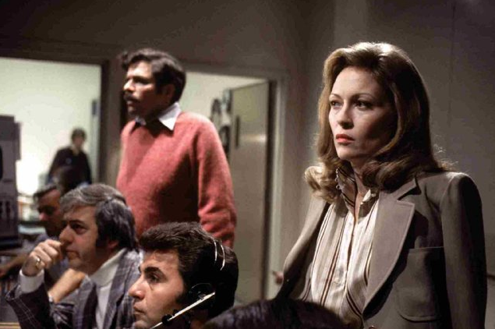
From My Collection: Network Movie Review (Special 300th Review Classic)

I sat simply stunned at how good a screenplay Network has. The opening titles read “Network – by Paddy Chayefsky,” as if it’s a novel. Rarely has there been a more apt use of a byline in movies than with this film that has one of the most literate screenplays ever produced in the history of the movies. Chayefsky was not afraid to use words that some audience members might not understand. More impressive than that is that a major Hollywood studio was willing to take a chance on it. Network didn’t break the bank at the domestic box office, but for its budget it was stupendous.

Monday, April 30, 2012

"If I Wanted to Kill You, You'd Be Dead Already": Godfather Analysis Part VI

Go to Part V: "Never tell anybody outside the family what you're thinking again."


I have argued that Pulp Fiction, despite what most people believe, is not actually a very violent film. I stick strongly to that belief. I don’t want to say the same thing about The Godfather because I believe it is rife with violence, but it is worth noting that the first violent scene (the garroting of Luca Brasi) comes 42 minutes into the film. This suggests that violence exists in the film only when necessary. It places the focus on family (the subject of the opening wedding celebration), on loyalty (the subject of the meetings Don Corleone has, as well as the help he provides Johnny Fontane), and it is about business (the subject of the meeting with Virgil Sollozzo).

Tuesday, April 24, 2012

"Never Tell Anybody Outside the Family What You're Thinking Again": Godfather Analysis Part V


Now that we’ve been introduced to all the major characters in the film, gotten a sense of their personality traits and seen the power of Don Corleone’s persuasion, it’s time (only 33 minutes into the film) to put the plot in motion and meet the villain. This section opens with Corleone sitting down with Tom and Sonny to begin discussing the possibility of becoming partners with Virgil Sollozzo. Vito asks Tom if he’s too tired and Tom remarks that it’s okay because he slept on the plane. This seemingly banal piece of dialogue does a few things: gives us a time reference so we know this is immediately after Tom’s trip to California; indicates Tom’s professionalism in his loyalty and service to the Don; and shows that the Don wants to get things moving quickly and be well-prepared.

Friday, April 20, 2012

"He Never Asks a Second Favor When He's Been Refused the First": Godfather Analysis Part IV

Go to Part III: "I'm gonna make him an offer he can't refuse."

The next section opens with some stock footage establishing shots of Hollywood and then a few long range shots of Tom making his way around the studio back lot until he finds the soundstage where Jack Woltz is. We know from the last conversation in Don Corleone’s office that Tom was meant to go to California that night. These establishing shots remind us of that conversation and the problem that Johnny is having with getting a part in a new war film.

Wednesday, April 18, 2012

"I'm Gonna Make Him an Offer He Can't Refuse.": Godfather Analysis Part III

Go to Part II: "No Sicilian can refuse any request on his daughter's wedding day."

The family portrait now includes Michael and Kay.
Now Johnny Fontane arrives to the great joy and surprise of Vito, who proclaims that he came “all the way from California.” Tom, being realistic and perhaps a little jealous, points out, “it’s been two years. He’s probably in trouble again.” Of course, Tom turns out to be right as he’s come to ask a favor of the Don.

Tuesday, April 17, 2012

"No Sicilian Can Refuse Any Request on His Daughter's Wedding Day.": Godfather Analysis Part II

Go to Part I: "I believe in America."

After the dark interior opening, the film cuts to a sunny exterior shot of the wedding celebration with music playing and people dancing. This virtuoso opening sequence brilliantly introduces us not only to most of the important characters in the film, but also to some of the key plot points, although we don’t know it yet. The opening sequence in Corleone’s office has an average shot length of just under 27 seconds. The remainder of the wedding sequence averages just under 8 seconds per shot – an indication that the sequence moves quickly, cutting between exterior and interior scenes, revealing all the characters and some of their personality traits that will figure prominently later.

Sunday, November 20, 2011

Classic Movie Review: The Godfather Part II

At the time it was made, could anyone have imagined that a sequel to The Godfather would possibly be anything near to the quality and sophistication of the first film? And yet Francis Ford Coppola surpassed his own film in many ways with The Godfather Part II. It is wider and more epic in scope, covering both the rise of a young Vito Corleone in 1920s Little Italy and the decline of his youngest son Michael 30-odd years later. It covers the ground both before and after the time period in which the first film is set.

Wednesday, November 16, 2011

"I Believe in America": Godfather Analysis Part I

Go to introduction.


That is the line that opens the film over a black frame before a fade in on a close-up of Bonasera. That line sets the tone for the rest of the film and possibly the entire trilogy. In many ways, the film is a celebration of the idea of America and the American dream: an immigrant family settles in New York and builds itself up from having nothing to having everything. America, the land of opportunity, has been very good to the Corleone family.

Monday, October 24, 2011

The Godfather Film Analysis: Introduction


This is the first introduction to a complete film analysis of The Godfather from 1972. It is still a work in progress and I hope to get it completed with all parts posted by the end of November. This is not meant as a full academic study, but the beginnings of exploring how sequencing, lighting, shot composition and music contribute to cinematic storytelling in great movies.


Unfortunately I am too young to have had the opportunity to see The Godfather when it first opened in 1972. I can recall seeing it in bits and pieces throughout my childhood on television, cable and probably on video. Certain images resonated and stuck in my mind: the garroting of Carlo and his kicking out the windshield; Sonny’s violent death at the tollbooth; Sonny’s beating of Carlo on the street; Jack Woltz waking to find himself covered in blood and the head of his prized racehorse under the sheets; Michael’s killing of McCluskey and Sollozzo; the final montage of the baptism inter-cut with the killings of the heads of the five families. It is certainly no coincidence that the most violent scenes are what stayed with me all my life. I never had any awareness of the plot of the film until I watched the film in its entirety sometime when I was a teenager.

Friday, October 21, 2011

Classic Movie Review: The Godfather (Special 200th Posted Review Edition)

This reviews marks the 200th full length movie review I've posted to this blog since I began it in April 2010. When I hit my 100th earlier this year, I marked the occasion with a review for Pulp Fiction, followed by a scene-by-scene analysis of the film. Starting next week, I will begin posting a similar analysis for The Godfather.


Francis Ford Coppola’s adaptation of Mario Puzo’s The Godfather is regarded as such an important cinematic classic that it’s easy to forget what a bold undertaking it was and how unconventional Coppola decided to make it. Here is  adramatic and violent story, epic in scope, that begins with a thirty minute wedding celebration that has very little plot advancement, no action, and introduces about twenty key characters. The payoff comes later when we feel like we know these people like our own family.

Saturday, January 1, 2011

Get Low Movie Review

Imagine you reach the end of your life as an old man in a small town. Everyone knows your name. You’re a legend. Stories are told about you across four counties. When your funeral is announced, thousands turn up to share in the celebration of your life. Now imagine it’s for all the wrong reasons – because you are reviled for being the king crazy old codger – and there you have the premise of Get Low, the feature debut of director Aaron Schneider.

Felix Bush is what can charitably be described as an ornery old recluse living in a cabin in 1930s Tennessee. Occasionally the kids from town come to get a glimpse of him or to throw a stone through one of his windows. He scares them off with a shotgun and posts a sign that reads, “No damn trespassing. Beware of mule!” It’s not clear if he’s referring to any domesticated animals he may or may not own.

Monday, June 7, 2010

Old Movie Review: Colors directed by Dennis Hopper

Here is the last of my reviews commemorating the career of the late Dennis Hopper. Unfortunately, this movie was hardly worth my time, but I stuck with it to the end. The last time I walked out on a movie was Father of the Bride Part II when I was 17. So here we have the 4th movie directed by Dennis Hopper. He left a much better legacy as an actor than as a director.

It’s almost not even worth writing anything about a 22 year old film that time has all but forgotten. The Dennis Hopper directed Los Angeles cops and gangs drama Colors has not survived the long lens of history very well. It’s true that most films from that period have not dated well. The fashions, the hairstyles and the musical scores in particular have a distinct late 80s feel in several police dramas from that period including Lethal Weapon and Beverly Hills Cop.

Everything I Saw in the 2nd Half of 2025

30 Dec. Hamnet (2025) [cinema]* 28 Dec. #4133 Song Sung Blue (2025) [cinema] 25 Dec. #4132 Marty Supreme (2025) [cinema] 16 Dec. #4131...