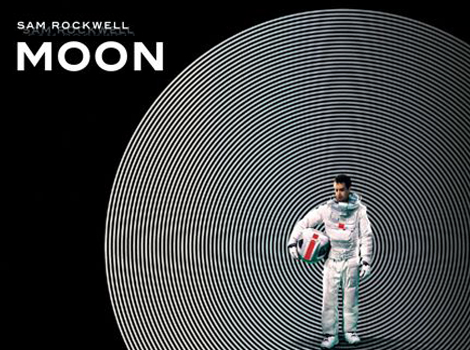
At some point while watching
Moon, I had a very troubling thought (more on that after the spoiler warning). I’m nearly certain this was the intent of Duncan Jones, in his directorial debut, and screenwriter Nathan Parker. The film made the festival circuit in early 2009 and received a limited release in early summer. But in a crowded summer market, there was simply no room for a sci-fi film based principally on ideas rather than action set pieces and CGI special effects.
The film takes place in a not-too-distant future in which the earth’s energy is now supplied by a substance that is harvested on the dark side of the moon. The process is mostly automated, but requires a human being to monitor and fix problems that arise. This unfortunate individual is Sam Bell (played in yet another in a series of great performances by Sam Rockwell), assigned to his post on a three year contract with the only company being a computer named Gerty and voiced by Kevin Spacey.
When the film opens, Sam is two weeks away from the end of his contract and the arrival of his replacement. As you can imagine, he is quite anxious to get home to his wife and young daughter, from whom he receives the occasional video message and is able to send messages in return. Unfortunately, the satellite link isn’t working, making live communication impossible.
There are obvious comparisons to be made with Kubrick’s
2001: A Space Odyssey in the tone of the film. Its pacing is quite deliberate and the story is focused on the nature of science, exploration, developments, but without the high-minded philosophical rambling. It’s even got a ubiquitous computer that controls the majority of the operations and is capable of doing most anything. The difference is that Gerty, unlike Hal, adheres more closely to Isaac Asimov’s Laws of Robotics – which turns out to be the crucial difference in how the relationship between man and machine plays out.
After having spent so much time in solitude, Sam has begun having glitches in perception which may or may not be hallucinations. One of these episodes leads to the crash of a lunar rover he uses to check the status of the harvesting machines. Left injured, unconscious and stranded after the accident he eventually wakes up in the infirmary being cared for by Gerty. He is told about a crash, but he has no memory of anything. When he gets up from the gurney he can barely stand, his legs almost debilitated.
Jones has got a promising future as a director of thoughtful films as long as he doesn’t get pulled in by the lure of genre and action pictures. The mystery that unfolds from the moments after the crash is revealed to both Sam and the audience simultaneously, expertly controlled by Parker’s screenplay and Jones’s direction. I also have to point out that the film would hardly be what it is without Clint Mansell’s musical score which provides a continually subdued sense of suspense and tension.
If you’ve read a plot synopsis or seen the trailer then you’ll have some idea what’s going on from this point. I do have some criticisms of the film, but I can’t really get into the specifics without issuing a
SPOILER WARNING: When Sam wakes up after his crash, he is forbidden from leaving the base despite a stalled harvester (the one he crashed into) that needs fixing. After tricking Gerty, he takes another rover to the crash site and discovers an unconscious body inside. Bringing the body back to the base he realizes it’s himself. We slowly discover together that at least one of them is a clone.
Here is one of the flaws, albeit a minor one, of the screenplay, which fails to provide a sufficient explanation for why Sam is compelled to ignore orders and go to the disabled harvester. We assume at first that he is driven to return to the site of his crash that he has no memory of. But in light of the revelation that the Sam who returns to the crash site is a different Sam who could have no knowledge of the crash or the existence of another Sam, there is little reason for his previous actions.
Okay, so we allow a bit of contrivance to move the plot along. It turns out the first Sam is not simply suffering from hallucinations, but a complete breakdown of his physical body. Everything is failing at once until he is nearly a shell of a man. What is the explanation for this? And why is there a clone ready to take over his duties at a moment’s notice? I ask these questions from Sam’s perspective, not as a critic or audience member.
Now I return to this terrible thought I had. I began to think of at least one of these Sams as a clone, not as a human being. I had this instinct that a clone is little more than a robot, a tool we can call forth to use and dispose of at will. This is exactly how clones are used by the mining company in
Moon. This is somehow the logical progression of the literary creations of Arthur C. Clarke and Philip K. Dick beginning with Hal in
2001, a complex machine with human qualities that exhibits more emotion in his death scene than in the whole of that film: “Stop Dave. Will you stop, Dave? My mind is going. I can feel it. I’m afraid, Dave. I’m afraid.” The next step was the replicants of
Blade Runner that desire to know their expiration date and prefer life over death. There’s also Rachel in that film, a replicant with memory implants that have led her to believe she is a young woman who grew up from childhood to where she is now. She is devastated to learn it’s all been falsified. Then there were the clones harvested for vital organs in
The Island.
Jones and Parker are interested in humanity’s attitude toward cloning and want to warn us of where that road could lead. Consider the Clone Wars discussed and depicted in the
Star Wars films. Did you ever consider the clones to be people? I never really internalized that feeling. It doesn’t help that those clones were clad in robotic looking suits. Will human cloning eventually become a reality? Almost certainly. Will it be used for nefarious purposes, with the intention of creating a class of laborers to be exploited? We should hope not.
The biggest fault of
Moon is its failure to consider or give an explanation for how the real Sam Bell and his wife came to give their consent for this project. I can come up with theories and “just so” stories to explain it, but it’s a big enough hole I shouldn’t have to fill on my own.
But don’t let the few faults deter you from seeing what is a substantially original production, both in its use of effects, which is natural looking and tasteful, and its use of scientific ideas and morals. It’s a rare occasion to find an independent movie this good with such big ideas. These films are always worth seeking out in spite of their occasional warts.
Update 15 May 2010 (12:50AM): I've just learned in reading more about this movie and its director, Duncan Jones, that he is the son of David Bowie. Just an interesting side fact.


